Blog Tour: Paris Never Leaves You

First, I would like to thank Clare Maurer and Maria Vitale at St.Martin’s Press for thinking of me when organizing this blog tour.

Synopsis

The war is over, but the past is never past …
 
Paris, 1944. Charlotte Foret is working in a tiny bookstore in Nazi-occupied Paris struggling to stay alive and keep her baby Vivi safe as the world around them is being torn apart. Every day they live through is a miracle until Vivi becomes gravely ill.  In desperation, Charlotte accepts help from an unlikely saviour – and her life is changed forever.
 
Charlotte is no victim – she is a survivor. But the truth of what happened in Paris is something she can never share with anyone, including her daughter. But can she ever really leave Paris behind – and survive the next chapter of her life?
 
Seamlessly interweaving Charlotte’s past in wartime Paris and her present in the 1950s world of New York publishing, Paris Never Leaves You is a heartbreakingly moving and unforgettable story of resilience, love – and impossible choices.

Review

Paris Never Leaves You is an historical novel about the German occupation of Paris during World War II. What stood out for me was that it showed the impact on civilians during a time of war. We see their daily struggle to get food and essentials. We understand their fears as their houses are no longer their homes, but instead commodities of war. Families are divided and move nightly to evade the German soldiers.

The effect of the war is palpable. Charlotte has lost a considerable amount of weight. Her father has fled the country. Her closest friend Simone has been arrested and her daughter Vivi is starving. And through all this a German soldier comes to her bookstore proffering food. At first she tells herself that she accepts his kindness out of necessity. Then she realizes that she has feelings for him that run deeper. She cannot admit or express how she truly feels. It seems like a betrayal. To her dead husband and to the people of Paris.

At the end of the war Charlotte and Vivi have both made it through. Their new lives in America are strained by the secrets of the past. Not only does survivor’s guilt weigh down heavily on Charlotte, but she also is ashamed of how she came to secure the life that she and Vivi now live.

I found the book slow going at first and had a hard time getting into it. When I read the blurb I thought it was going to be more about books because of the bookstore and publishing angles. However, I did appreciate learning another aspect of World War II that is rarely depicted in books. I never thought of a Jew serving in the German army or others using Jewish classification to escape war. I found this whole concept of “hiding in plain sight” intriguing and was touched by both Julian’s and Charlotte’s stories.

Meet the Author

Ellen Feldman, a 2009 Guggenheim fellow, is the author of Terrible Virtue, The Unwitting, Next to Love, Scottsboro (shortlisted for the Orange Prize), The Boy Who Loved Anne Frank (translated into nine languages), and Lucy. Her last novel, Terrible Virtue, was optioned by Black Bicycle for a feature film.

Ellen has lectured extensively around the country and in Germany and England, and enjoys talking to book groups in person, on the phone, or via the web.

She grew up in northern New Jersey and attended Bryn Mawr College, from which she holds a B.A. and an M.A. in modern history. After further graduate studies at Columbia University, she worked for a New York publishing house.

Ellen lives in New York City and East Hampton, New York, with her husband and a terrier named Charlie.

Where You Can Find Ellen

Buy Links

Blog Tour Spotlight: In the Neighborhood of True

Synopsis

A powerful story of love, identity, and the price of fitting in or speaking out.

After her father’s death, Ruth Robb and her family transplant themselves in the summer of 1958 from New York City to Atlanta—the land of debutantes, sweet tea, and the Ku Klux Klan. In her new hometown, Ruth quickly figures out she can be Jewish or she can be popular, but she can’t be both. Eager to fit in with the blond girls in the “pastel posse,” Ruth decides to hide her religion. Before she knows it, she is falling for the handsome and charming Davis and sipping Cokes with him and his friends at the all-white, all-Christian Club.

Does it matter that Ruth’s mother makes her attend services at the local synagogue every week? Not as long as nobody outside her family knows the truth. At temple Ruth meets Max, who is serious and intense about the fight for social justice, and now she is caught between two worlds, two religions, and two boys. But when a violent hate crime brings the different parts of Ruth’s life into sharp conflict, she will have to choose between all she’s come to love about her new life and standing up for what she believes.


Thoughts on the Book

“The story may be set in the past, but it couldn’t be a more timely reminder that true courage comes not from fitting in, but from purposefully standing out . . . and that to find out who you really are, you have to first figure out what you’re not.” —Jodi Picoult, New York Times bestselling author of A Spark of Light and Small Great Things


“gorgeous story about a teenage girl finding her voice in the face of hate, heartbreak, and injustice” —Nova Ren Suma, #1 New York Times bestselling author of A Room Away from the Wolves


“Carlton captures the racism, anti-Semitism, and social interactions of the time and place with admirable nuance. The dialogue and setting are meticulously constructed, and readers will feel the humidity and tension rising with each chapter.” — Publisher’s Weekly; starred review

My Thoughts

In the Neighborhood of True is a captivating novel based on the 1958 bombing of Hebrew Benevolent Congregation Temple. As Atlanta’s first official Jewish institution The Temple not only served as a beacon within the Jewish community, but under the leadership of Rabbi Jacob Rothschild it also was a center for social justice and the burgeoning civil rights movement.

Carlton manages to capture this fraughtful time through the eyes of a Jewish girl coming of age in the wake of her father’s death. Ruth is smitten with the debutante scene and the handsome young Davis Jefferson. She is warned by her grandmother that her Jewishness might set her apart from the in-crowd and so at first she “passes” for Christian. But as time goes by she realizes that her lies of omission are a wedge between her and true acceptance by her new friends. Ultimately, she must decide which side she wants to be on — somewhere “in the neighborhood of true” where no one knows who she really is — or on the side of truth and justice and doing what’s right.


Meet the Author

From the author’s website:

“I grew up in San Francisco and its suburbs, went to college in Portland, Oregon and interned in the White House. From there, I got a master’s degree in journalism from Columbia University and worked in magazines—Self, Elle, Mademoiselle, and others. That may explain my perennial crush on polka dots, poodles, and vintage stores.

A while ago, my family moved to Atlanta where we became members of a temple not so very different from the one in In the Neighborhood of True. We were welcomed with a hearty “Shabbat shalom, y’all,” but the memories of what happened there still reverberated. Our younger daughter attended Sunday school in one of the classrooms that had been bombed decades before. And the hate has continued to echo. In 2017, in Charlottesville, Virginia, where our older daughter is in school, white nationalists brandished torches in front of Thomas Jefferson’s rotunda, yelling, “Jews will not replace us.” And then the next year in Pittsburgh, eleven congregants were shot during Saturday morning services. I watched the unfolding horror on TV news with my eighty-eight-year-old father, remembering the bat mitzvah the whole family had attended at a different synagogue nearby. As the names of the dead were read, I kept thinking that my dad could have been one of them. And then I thought, it could have been any of us—over and over, across decades and state lines.

These days, I teach writing at Boston University and write young adult novels about complicated girls in complicated times. My husband and I have moved our two amusing and good-natured daughters up and down the East Coast. We now live in Hanover, New Hampshire, where we think we’ll stay.”

Where you can find Susan K. Carlton

The Girls With No Names by Serena Burdick

The Girls with No Names takes the reader back to a time where women were still fighting to be heard. The Women’s Suffrage movement was just starting to make headway. But women were still beholden to the patriarchal standards of society. If a woman did not conform, rebelled or acted “inappropriately” she could be sent away to a sanitorium. One of these houses for wayward women was the House of Mercy on 86th St and 5th Ave. in Manhattan. Its public aim was to rescue women from vice but in actuality it was a Magdalene laundry. The women were not redeemed from their sin, but imprisoned and exploited for free labor.

House of Mercy, Inwood NY circa 1910

Effie and Luella are inseparable. Effie, born with a heart defect, has spent her life under her mother’s watchful eye and her older sister’s shadow. Luella is strong, spirited and outspoken. One day the two sisters are drawn to a field by beautiful flute music. The bonds that they form with the Romani camped here threaten their idle existence. Ignorance and bigotry cause Luella to run away. Believing that her sister was sent to the House of Mercy for her defiance, Luella hatches a plan to have her returned home. It’s a rather simple plan – get admitted to House of Mercy herself and her parents will have to come and rescue them both. The only problem is Luella isn’t at House of Mercy and no one knows that Effie is there.

Of the three perspectives that this story was told: Effie, her mother Jeanne and House of Mercy girl Mable, I enjoyed Effie’s the most. Her innocence was beguiling and I was really drawn to her character. The other women’s narrative meshed nicely with hers and fit in the missing puzzle pieces to her story.

The Girls with No Names is Serena Burdick’s second novel. Her debut, Girl in the Afternoon, won the 2017 International Book Award for Historical Fiction

My only problem with the book was the repeated use of the word gypsy. I found myself cringing every time the word appeared on the page. Because I felt compelled to hear Effie’s story and I recognized that Burdick was not disparaging the Romani people but exposing their detractors, I mentally went about scratching out the word g***y and replacing it with Romani. Although Burdick explains her use of the word in the Afterword, I am not sure if I were a member of the Romani if this explanation would slide with me. I can tell you that when I have seen racial slurs for African-Americans in literature I get highly offended.

Special thanks to NetGalley, Justine Sha at Harlequin/Park Row Publishers and Serena Burdick for advanced access to this book.

A revelatory reimagining of the slave narrative

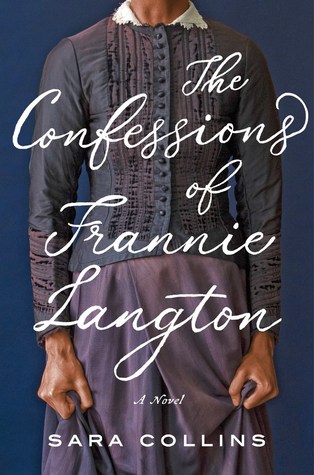
Frannie Langton is a mulatta woman in 19th century England being tried for the murder of her master and his wife. She protests her innocence but gives us Confessions as her accounting. Gothic in style, The Confessions of Frannie Langton turns the typical slave narrative on its head. Although our protagonist makes it a point to say that she does not want to focus on the abomination that is slavery her testimony makes it hard to overlook these atrocities.

I could not help but make comparisons to Edugyan’s Washington Black. The parallels that I saw between the two books were:

Both looked at science and discovery in the 1800’s and how the scientific method was both driven by and overlooked because of racial prejudice.
Both protagonists are unaware of their mother’s identity until they reach adulthood. Each faces the inherent abandonment issues of motherless children – the trauma suffered by the separation of families and loss of identity. In addition both Frannie and Washington must deal with the guilt and horror of the sins committed against these parents when they knew not who these women were, all at once realizing the supreme sacrifice that each of their mothers gave.
Both were enamored with their enslaver. In the case of Washington it was Titsch. He simply could not see his faults or how he was being used for Titsch’s own ends. He was more naive then Frannie and didn’t come to realize that he was not valued or appreciated in the sense that he wanted to be. For Frannie it is her mistress whom she falls in love with. She gets her addicted to laudanum and takes advantage of her position. The old story of master raping and manipulating his slaves is well known and often seen in literature. Although we recognize that power is a potent intoxicating drug, we often don’t consider that power is power regardless of who is wielding the sword.

Now Frannie is not innocent by any means. She has had her hands dirty and has committed her own crimes. Frannie also admits to being angry and how this anger has subsumed her and followed her throughout her life. But in the end The Confessions of Frannie Langton is about taking power over your own voice. This was evident when “Lightning Laddy” was relaying a story his mother told him as a child about the Asiki. The Asiki were changelings – African children stolen and transformed by witches so that not only their appearance changed but that they also lost their ability to talk along with their memories. The question posed was “What would they tell us if they did have tongues?”  What of the exceptional Negro? Do they suffer the same as every other black? Are they used as pawns to perpetuate stereotypes and racist agenda? To answer those “well meaning” white abolitionists who bind the African by their stunted definitions and implicit racism Laddy Lightning replies: “Here’s the rub. You asking me to speak for them. How can I? Why have you asked me? Because you look at a single black man and see all black men. As if one black man is representative of every member of his race. Allowed neither personality nor passion.”

There were so many parts of this book that moved me. Both the language and the content were stirring. I am impressed. Bold. Absolutely refreshing.

What’s in a Name?

The Guest Book by Sarah Blake. 

The Guest Book is as much a family saga as it is a love story.  But what will perhaps carry this book through the ages is that it speaks to the heart of American society and privilege.  Kitty and Ogden Milton have power and prestige.  They are considered American royalty. Their legacy is not simply one of wealth but of morals and values as well.

Let’s first consider the guest book as an historical record.  Evelyn Milton is a history professor whose life’s work examines the role of the silent women in history.  She beseeches her students to consider the historical record.  Who gets to tell the story?  What part of history is actual fact?  How much of the story is missing?  One must not just consider different perspectives but acknowledge that facts, details, entire lives may have been erased.  In the end how does one verify the truth in what has been documented? 

More importantly, The Guest Book shows the legacy of prejudice and how our abuses of power and privilege are rooted in our value systems.  Kitty is Queen Bee of the Milton clan.  She has instilled in her children a list of “Ought Tos” and “Ought Nots” that will allow them to engage in polite society. It is these rules that also perpetuate the oppression of the disenfranchised.

I think that it is key that Reg Pauling’s name never appeared in the guest book even though he played a critical role on the night of the party.  In his own life he was quite successful as a journalist for The Village Voice.  He was well educated.  He lived a life worth the telling, a life worth being seen.  Yet, ala Ralph Ellison he is delegated to being “The Invisible Man”.  Kitty opens herself up to him because he seems so unassuming.   Len Levy, in contrast, is a man whose presence looms large.  He is ambitious, earnest in his speech and radiates confidence.  Kitty sees parallels between Levy and her husband Ogden.  For Ogden she sees these qualities as the source of his strength but for Len it is off putting.  As a Jew he was not supposed to take up that type of space.  He was not supposed to fill up a room with his presence.  So although Len Levy’s name does appear in the guest book it is not by Kitty’s offering but by Evie’s sleight of hand as she tries to hide her affair.  Levy gets acknowledged in the book but the feeling is that his name does not belong there.  Len does not belong to that society even though he has earned that right for himself.  Sarah Blake does a fine job exploring how nuanced power plays and discrimination can be within American society.

From the blurb: “An unforgettable love story, a novel about past mistakes and betrayals that ripple throughout generations, The Guest Book examines not just a privileged American family, but a privileged America. It is a literary triumph.”